
Project Results
Context and stakeholders analysis for historic examples of political participation (D1.2)
The aim of the context and stakeholder analysis is to gather information and data that will allow to better understand the temporal, social, and spatial scope and circumstances in which Collective Action Initiatives (CAIs) emerged and evolved within the 18 historical case studies (HE) analyzed.
Project Deliverable:
Download D1.2Other outputs:
Download summaryImpact Assessment Framework (D1.3)
The Impact Assessment Framework (IAF) provides a roadmap for the impact assessment of deliberation panels, including indicators and goals. IAF’ s goal is to gain a comprehensive understanding of the impact of the interventions co-created with the case study groups. For this, IAF defines approaches and tools to evaluate changes at both the individual level (through individual interviews and surveys) and the group level (using impact stories and participatory observation of deliberative processes). As such, the IAF enables qualitative and quantitative assessment of the changes brought about by project interventions in terms of social cohesion, empowerment, inclusion/exclusion, and capacity and community building.
Project Deliverable:
Download D1.3Other outputs:
Download summaryLiterature review on the triggers and management of latent and manifest forms of political participation (D2.1)
This paper reviews the literature on triggers and management of latent and manifest forms in the context of climate transition. The report provides a thorough analysis of existing knowledge on political participation related to environmental, political and social priorities. The method employs a systematic literature review based on the Web of Science, Scopus and Google Scholar databases, with queries built around three main topics: triggers for change, forms of participation and strategies for demanding social change. CADIMA record management software was used for screening and selection, and consistency was maintained through double-independent evaluation based on established criteria. This thorough procedure led to the selection of a group of 77 articles (from the original database of 444 records) for in-depth qualitative and quantitative evaluation.
Project Deliverable:
Download D2.1Other outputs:
Download summaryCross-case analysis of the triggers, management and impact of latent and manifest forms of political participation (D2.2)
The report provides a comprehensive cross-case analysis of the triggers, management, and impacts of latent and manifest forms of political participation, with a focus on Collective Action Initiatives (CAIs) across diverse socio-political and environmental contexts. The report employs a multi-methodological approach, integrating semi-structured interviews, textual analysis, social network analysis, and system mapping within the Multi-Level Perspective (MLP) framework. This analysis aims to elucidate the dynamics of political participation, its evolution, and its implications for democratic innovation and sustainability transitions.
Draft of the Project Deliverable:
Download D2.2Other outputs:
Download summaryAnalysing best (and worst) practices to support and manage latent and manifest forms of political participation (D2.3)
The main objective of this report was to identify key lessons, strategies, or factors that influence and shape political participation for a democratic climate transition. Special emphasis was placed on determining which factors were perceived as most and least influential in promoting political participation. The task also aimed to summarise general insights into the factors that support different modes of political engagement, assess how specific contextual features shaped participation, and illustrate these dynamics with qualitative evidence. Additionally, where relevant, extra indicators were considered based on the specifics and data availability of each case.
Draft of the Project Deliverable:
Download D2.3Other outputs:
A short article reflecting on the enabling and hindering factors for latent and manifest forms of political participation produced by researchers at Ecoserveis Download article Download summaryResults of deliberation panels (D3.1)
This deliverable presents the implementation and preliminary outputs of deliberative processes conducted in six case studies in five different countries (Italy, Finland, Estonia, Austria, and Spain) to investigate the conditions underlying different forms of political participation, the potential of social innovation to be expanded, and the capacity of democratic governance to address climate challenges by mobilizing, engaging, and interacting with citizens. The methodology for the case studies has been designed and finalized in a dedicated Deliverable 2.4 (Frolova et al. 2025). Before the deliberative panels, each case study conducted contextual and stakeholder analysis to identify appropriate actors, institutional conditions, and opportunities for change. Participatory System Mapping (PSM), Causal Loop Diagrams (CLDs), and Theory of Change (ToC) provided the main methodological framework for the CO-SUSTAIN deliberative process. The process consisted of four events: a kick-off meeting and three deliberative panels. Deliverable 3.1 presents participants involved, and outputs generated by the case studies. Attendance at some of the events was lower than originally planned. Small participation numbers created both limitations and advantages. Sometimes it restricted the range and scope of perspectives, but then in some cases it also provided ample speaking time and gave room to intense discussions. Levels of participation of niche and regime level actors influenced the discussions and resulting processes. Case studies that had bridging actors connected to both community initiatives and institutional structures were better able to bring together different levels of perspectives and helped promote co-created solutions. Theory of Change helped the case studies translate identified leverage points from the system mapping exercises to more concrete pathways for actions. Pathways vary considerably between the case studies but demonstrate that common methodological framework enabled participants to move from mapping system dynamics to leverage points and then towards concrete actions. The theme that occurred was the significance of collaboration and bridging between different actors and governance. Several cases proposed that efforts should be made to create spaces for coordination, co-design or dialogue. Deliverable 3.1 provides both a record of the participatory part of process and a foundation for the next analytical stages of the CO-SUSTAIN project.
Draft of the Project Deliverable:
Download D3.1Other outputs:
Download summaryAssessment of the outputs and outcomes (D4.1)
This report presents the assessment of the outputs (direct activities and deliverables produced by an intervention) and short-term outcomes (changes in participants' actions, attitudes, understandings, relationships) of the deliberation processes conducted within the CO-SUSTAIN project, examining their potential to support a sustainable and inclusive transition. Guided by the Impact Assessment Framework (IAF) (Deliverable D1.3), the assessment combines qualitative and quantitative evidence from participant surveys, interviews, impact stories, and participatory observation to examine changes at individual and group levels. It considers how the deliberative processes and tools used influenced participants’ understanding of the challenges addressed, recognition of their systemic nature and identification of possible solutions, alongside changes in social cohesion, empowerment, inclusion and exclusion, and capacity and community building. The assessment focuses on outputs and short-term outcomes that can be examined within the project’s timeframe, providing a basis for understanding how deliberation may contribute to longer-term change.
Draft of the Project Deliverable:
Download D4.1Cross-case comparative analysis (D4.2)
This report compares the implementation and results of the six deliberation processes conducted within the CO-SUSTAIN project between November 2025 and June 2026: public space regeneration in Annelinn (Tartu), resident participation in large-scale energy projects (Espoo), the Westbahnareal campaign (Vienna), the food solidarity system of Turin, an inclusive shared-energy network in El Raval (Barcelona) and an energy community in the Alpujarra (Órgiva). It asks under which conditions, and through which factors and dynamics, participation produces which effects on democratic pathways to transition. Drawing on the multi-level perspective, social movement theory, Ekman and Amnå’s typology of participation, Tilly’s theory of collective action and participatory, deliberative and prefigurative democracy, the comparison follows a context–mechanism–outcome logic in three stages: contexts, implementation and outcomes. The analysis finds that regime stability rests less on open opposition than on political inertia, administrative constraints, organisational fatigue and forms of participation that do not redistribute power. It distinguishes three patterns of niche–regime interaction: embedded niches (Turin, Barcelona), contested niches (Vienna, Órgiva) and invited participation (Tartu, Espoo). The deliberation processes were researcher-facilitated stakeholder forums, not linked to formal decision-making, and largely reproduced existing relations, so the presence of the relevant regime actors at the final joint panel proved decisive. Outcomes are still emerging and mostly cognitive and relational: a more systemic understanding of the problem, its reframing in terms of justice, and greater mutual recognition and trust. Governance outcomes are limited to proposals and stronger cooperation, and only Barcelona has begun implementation. The findings confirm the role of bridging actors, funding and legal frameworks, and show that regime openness shapes decision-makers’ involvement across levels of government. The report therefore recommends context-sensitive approaches over a one-size-fits-all model: involve the relevant level of government from the start, build on existing interfaces, link participation to the planning cycle, support the material conditions of grassroots and vulnerable groups, and plan follow-up and implementation from the outset.
Draft of the Project Deliverable:
Download D4.2Policy recommendations for a sustainable and democratic transition (D4.3)
This deliverable will be available once approuved.
Communication Material
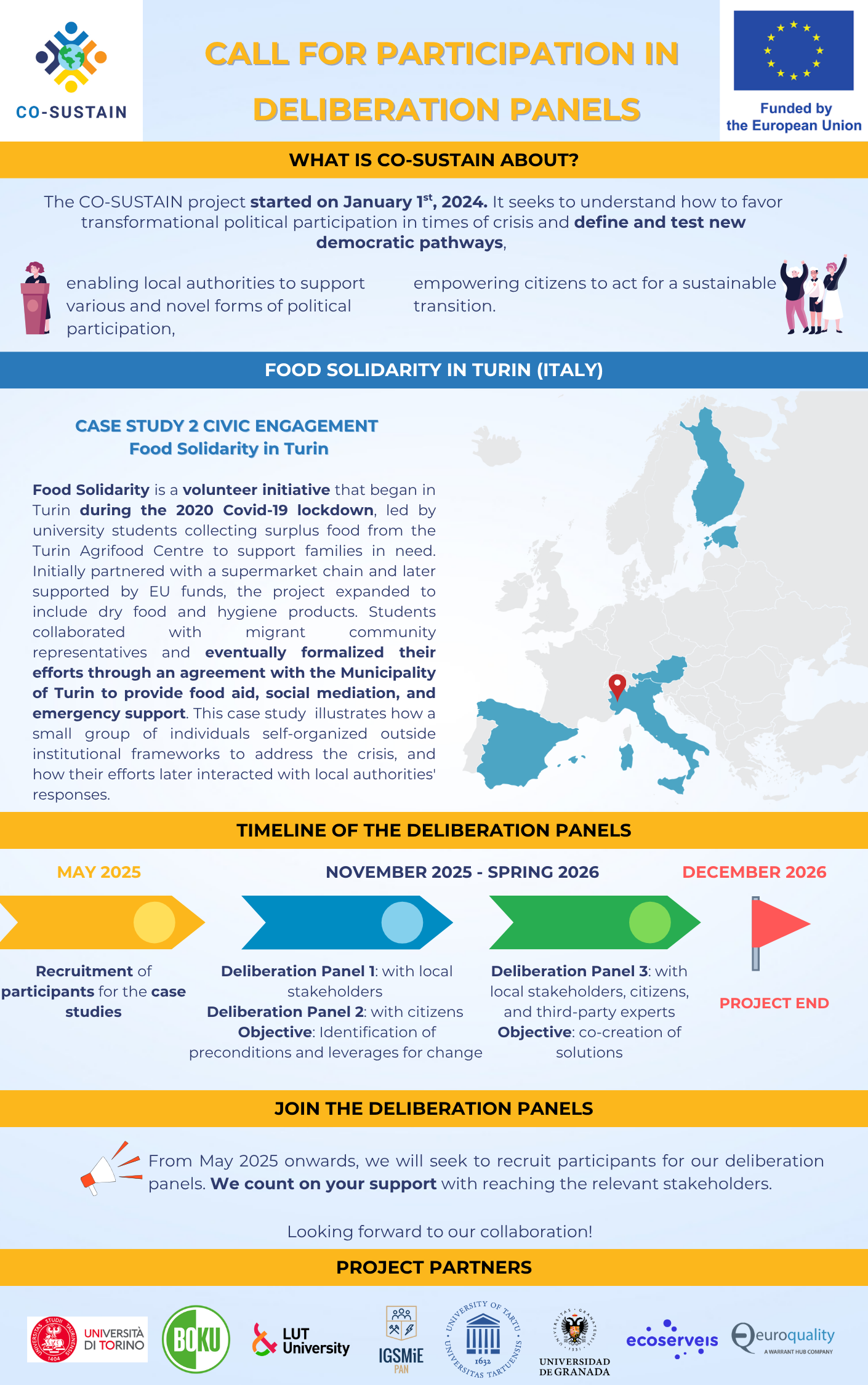
One-pagers presenting the case studies
Explore our one-page summaries, designed to share key insights and invite participants to our deliberation panels. Available for download in English and each case study’s local language
CO-SUSTAIN
Bürger*innen und Entscheidungstragende gemeinsam in’s Handeln bringen
ENTDECKEN
RECHTLICHE HINWEISE
Private Politik
Finanziert von der Europäischen Union. Die geäußerten Ansichten und Meinungen sind jedoch ausschließlich die der Autor*innen und spiegeln nicht unbedingt die der Europäischen Union oder der Europäischen Exekutivagentur für die Forschung wider. Weder die Europäische Union noch die Bewilligungsbehörde können für sie verantwortlich gemacht werden.
 German
 English
 Italian
 Spanish
 Estonian
 Finnish
 Polish